
All Articles
HR data integration: How an ETL service accelerates hiring decisions
Greg Crawley
June 25, 2025

HR data integration defined
In short, HR data integration pulls candidate contact details, test scores and other recruiting information into one dependable dataset so hiring teams can act immediately instead of cross-checking spreadsheets.
Why an ETL service matters for HR data integration
An ETL service removes the manual lookups, copy-pasting, and error chasing that slow down recruiting coordinators. Our previous CRM data integration case study documents how hours vanish when staff must “fix spreadsheets instead of planning campaigns,” a pain HR teams recognise during every intake cycle. By automating the extract, load, and transform steps in a no-code, conversational UI, Roboshift lets recruiters focus on evaluating people rather than repairing cells.
ETL service workflow inside HR data integration
The recruiter starts by dropping the contact list and the score sheet into Roboshift’s Sources view. Within seconds, the platform labels one file as personal data and the other as assessment points, confirming that both inputs are correct.
A live preview then appears, letting the user verify that the shared Email field matches across both datasets—for example, Amy Riddle and Lucas Russell carry identical addresses in each file.
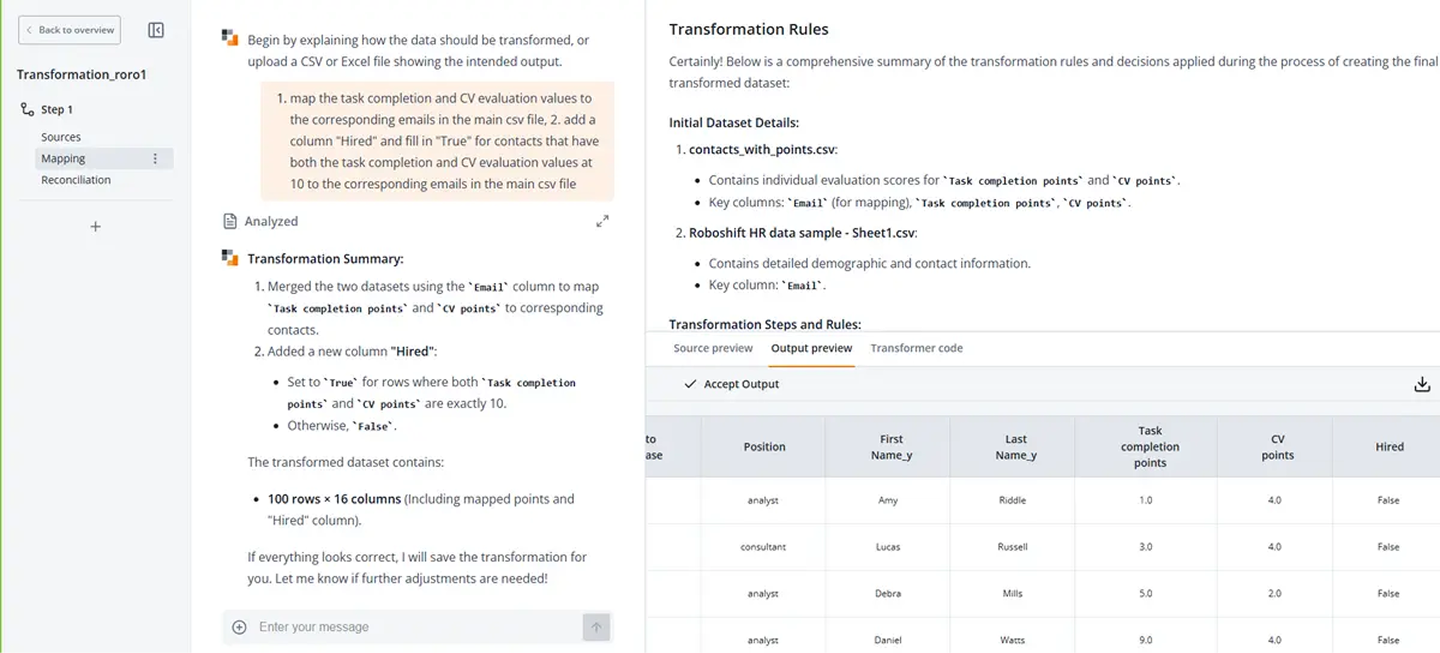
To decide who advances, the recruiter types a plain instruction: add a Hired column and set it to True when Task completion points and CV points both equal ten. Roboshift joins the records on Email, applies the rule, and displays the combined table almost instantly.
AI-based validation secures HR data integration
Before export, Roboshift runs a reconciliation pass that flags duplicate e-mails or missing values while the recruiter still has context to correct them. This early guardrail keeps personal information consistent across every hiring round.
With any issues fixed, the recruiter downloads a consolidated CSV or pushes the dataset straight into the applicant-tracking system—confident that every qualified candidate appears and no high scorer slips through a formula gap
Business impact of faster HR data integration
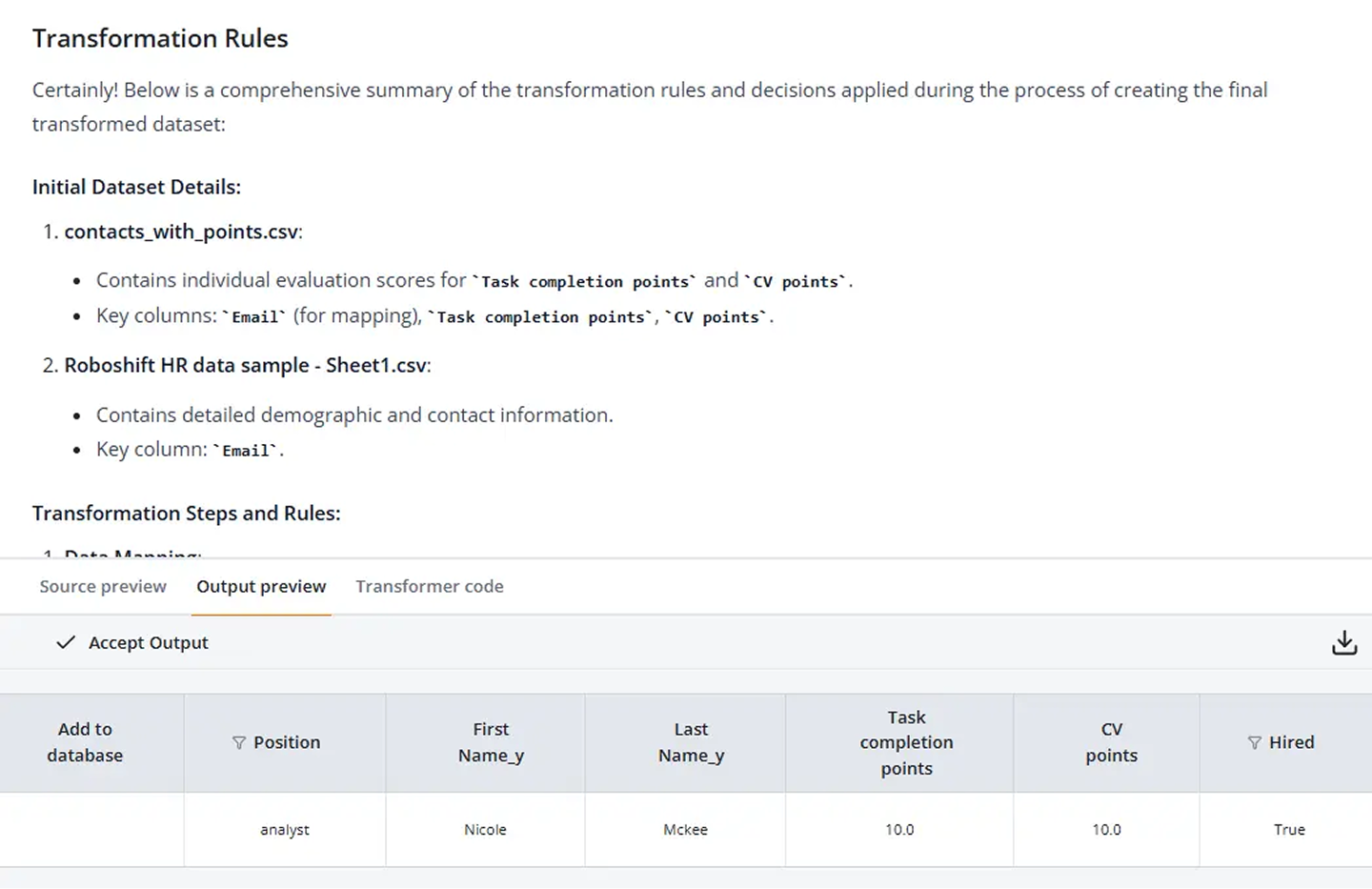
The complete merge-and-score cycle now finishes in under fifteen minutes, replacing the multi-hour Excel routine. Managers receive accurate shortlists sooner, recruiters spend more time interviewing, and data operations gain an auditable process that can be reused whenever fresh scores arrive. As requirements evolve, new inputs such as interview feedback or aptitude metrics can be folded into the same flow by adding one more plain-language rule, keeping the integration routine flexible without extra code.
The read-rule-release framework for ongoing HR data integration
Roboshift turns continuous hiring into a three-move rhythm: read fresh files, apply the standing rule, then release a clean dataset to the talent system. Because the configuration never resets, each new hiring wave repeats the cycle with only a few clicks—keeping HR data integration dependable and current.
Next steps? Start your HR data integration with Roboshift
Ready to cut hours of spreadsheet work and lower recruitment costs? Book a demo at Roboshift and see how fast HR data integration and transformation can be. The session provides a clear view of the Roboshift platform in action, helping your team decide whether Roboshift aligns with current objectives.
Get started with Roboshift
– schedule a free demo
Schedule a Demo


Deployment & Architecture
FAQs
Blog
Contact Us


© 2026 Roboshift. All rights reserved. Powered by Blocshop

All Articles
HR data integration: How an ETL service accelerates hiring decisions
Greg Crawley
June 25, 2025
HR data integration defined
In short, HR data integration pulls candidate contact details, test scores and other recruiting information into one dependable dataset so hiring teams can act immediately instead of cross-checking spreadsheets.
Why an ETL service matters for HR data integration
An ETL service removes the manual lookups, copy-pasting, and error chasing that slow down recruiting coordinators. Our previous CRM data integration case study documents how hours vanish when staff must “fix spreadsheets instead of planning campaigns,” a pain HR teams recognise during every intake cycle. By automating the extract, load, and transform steps in a no-code, conversational UI, Roboshift lets recruiters focus on evaluating people rather than repairing cells.
ETL service workflow inside HR data integration
The recruiter starts by dropping the contact list and the score sheet into Roboshift’s Sources view. Within seconds, the platform labels one file as personal data and the other as assessment points, confirming that both inputs are correct.
A live preview then appears, letting the user verify that the shared Email field matches across both datasets—for example, Amy Riddle and Lucas Russell carry identical addresses in each file.
To decide who advances, the recruiter types a plain instruction: add a Hired column and set it to True when Task completion points and CV points both equal ten. Roboshift joins the records on Email, applies the rule, and displays the combined table almost instantly.
AI-based validation secures HR data integration
Before export, Roboshift runs a reconciliation pass that flags duplicate e-mails or missing values while the recruiter still has context to correct them. This early guardrail keeps personal information consistent across every hiring round.
With any issues fixed, the recruiter downloads a consolidated CSV or pushes the dataset straight into the applicant-tracking system—confident that every qualified candidate appears and no high scorer slips through a formula gap
Business impact of faster HR data integration
The complete merge-and-score cycle now finishes in under fifteen minutes, replacing the multi-hour Excel routine. Managers receive accurate shortlists sooner, recruiters spend more time interviewing, and data operations gain an auditable process that can be reused whenever fresh scores arrive. As requirements evolve, new inputs such as interview feedback or aptitude metrics can be folded into the same flow by adding one more plain-language rule, keeping the integration routine flexible without extra code.
The read-rule-release framework for ongoing HR data integration
Roboshift turns continuous hiring into a three-move rhythm: read fresh files, apply the standing rule, then release a clean dataset to the talent system. Because the configuration never resets, each new hiring wave repeats the cycle with only a few clicks—keeping HR data integration dependable and current.
Next steps? Start your HR data integration with Roboshift
Ready to cut hours of spreadsheet work and lower recruitment costs? Book a demo at Roboshift and see how fast HR data integration and transformation can be. The session provides a clear view of the Roboshift platform in action, helping your team decide whether Roboshift aligns with current objectives.
Get started with Roboshift
– schedule a free demo
Schedule a Demo

Deployment & Architecture
Blog
FAQs
Contact Us


© 2026 Roboshift. All rights reserved. Powered by Blocshop

All Articles
HR data integration: How an ETL service accelerates hiring decisions
Greg Crawley
June 25, 2025
HR data integration defined
In short, HR data integration pulls candidate contact details, test scores and other recruiting information into one dependable dataset so hiring teams can act immediately instead of cross-checking spreadsheets.
Why an ETL service matters for HR data integration
An ETL service removes the manual lookups, copy-pasting, and error chasing that slow down recruiting coordinators. Our previous CRM data integration case study documents how hours vanish when staff must “fix spreadsheets instead of planning campaigns,” a pain HR teams recognise during every intake cycle. By automating the extract, load, and transform steps in a no-code, conversational UI, Roboshift lets recruiters focus on evaluating people rather than repairing cells.
ETL service workflow inside HR data integration
The recruiter starts by dropping the contact list and the score sheet into Roboshift’s Sources view. Within seconds, the platform labels one file as personal data and the other as assessment points, confirming that both inputs are correct.
A live preview then appears, letting the user verify that the shared Email field matches across both datasets—for example, Amy Riddle and Lucas Russell carry identical addresses in each file.
To decide who advances, the recruiter types a plain instruction: add a Hired column and set it to True when Task completion points and CV points both equal ten. Roboshift joins the records on Email, applies the rule, and displays the combined table almost instantly.
AI-based validation secures HR data integration
Before export, Roboshift runs a reconciliation pass that flags duplicate e-mails or missing values while the recruiter still has context to correct them. This early guardrail keeps personal information consistent across every hiring round.
With any issues fixed, the recruiter downloads a consolidated CSV or pushes the dataset straight into the applicant-tracking system—confident that every qualified candidate appears and no high scorer slips through a formula gap
Business impact of faster HR data integration
The complete merge-and-score cycle now finishes in under fifteen minutes, replacing the multi-hour Excel routine. Managers receive accurate shortlists sooner, recruiters spend more time interviewing, and data operations gain an auditable process that can be reused whenever fresh scores arrive. As requirements evolve, new inputs such as interview feedback or aptitude metrics can be folded into the same flow by adding one more plain-language rule, keeping the integration routine flexible without extra code.
The read-rule-release framework for ongoing HR data integration
Roboshift turns continuous hiring into a three-move rhythm: read fresh files, apply the standing rule, then release a clean dataset to the talent system. Because the configuration never resets, each new hiring wave repeats the cycle with only a few clicks—keeping HR data integration dependable and current.
Next steps? Start your HR data integration with Roboshift
Ready to cut hours of spreadsheet work and lower recruitment costs? Book a demo at Roboshift and see how fast HR data integration and transformation can be. The session provides a clear view of the Roboshift platform in action, helping your team decide whether Roboshift aligns with current objectives.
Get started with Roboshift
– schedule a free demo
Schedule a Demo

