
All Articles
EU AI Act checklist: building compliant data pipelines before the 2026 enforcement date
Greg Crawley
August 7, 2025

The EU AI Act entered into force on 1 August 2024 and rolls out in phases through 2 August 2026, with fines of up to €35 million or 7 % of global turnover for non-compliance. For teams running large analytical workloads, the shortest route to compliance is a well-designed EU AI Act data pipeline that can surface lineage, quality, and risk evidence on demand. Start with our EU AI Act checklist.
Why data pipelines sit at the core of EU AI Act compliance
High-risk AI systems must log every processing step, prove dataset integrity, and offer auditability from raw input to model output. If these controls live inside the pipeline itself—rather than scattered across manual scripts—organisations can satisfy the Act’s record-keeping, transparency, and human-oversight duties with less engineering effort.
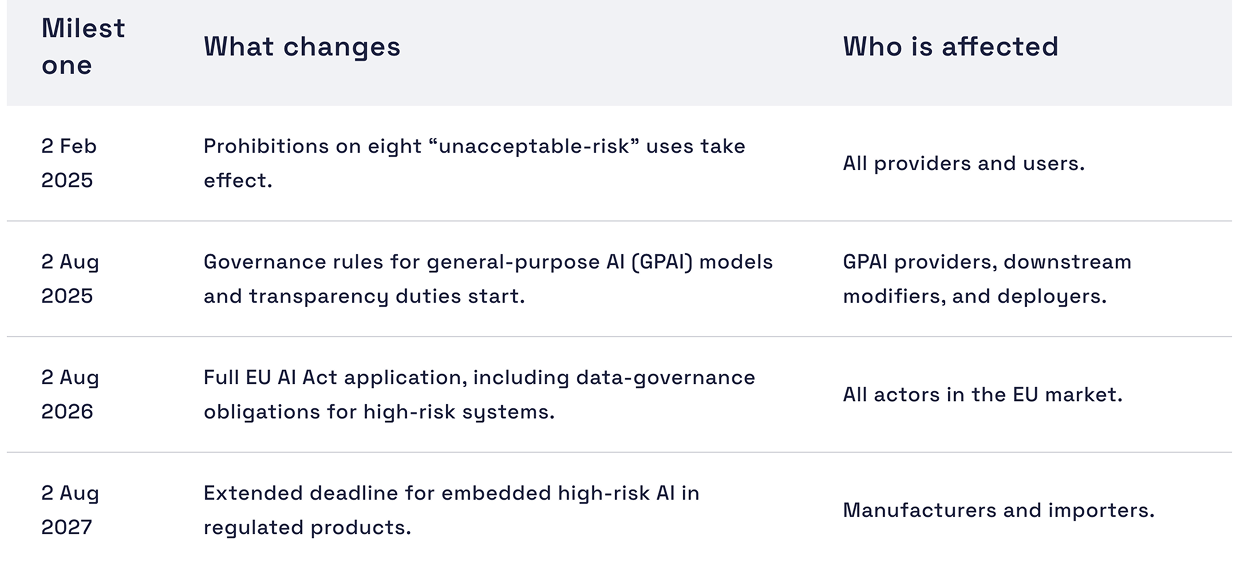
Key EU AI Act milestones at a glance
EU AI Act checklist: 10 steps for a compliant data pipeline
1. Inventory every AI-related dataset
Build a live catalogue that tags input, training, validation, and output tables, plus their sources and licences.
2. Classify pipeline risk
Map each model or analytic job to the Act’s risk tiers; label high-risk runs for extra scrutiny.
3. Set data-quality thresholds
Enforce completeness, accuracy, and bias rules at ingestion; reject rows that fail.
4. Log transformations automatically
Capture column-level lineage, processing code versions, and parameter hashes for every run.
5. Store consent and legal-basis metadata
Attach GDPR purpose, retention, and subject-rights flags to each dataset.
6. Enable human oversight hooks
Provide pause, rollback, and override controls so operators can intervene when alerts fire.
7. Generate technical documentation on demand
Output a machine-readable compliance report (JSON, PDF) covering risk assessment, data sources, and validation tests.
8. Secure third-party connectors
Verify that external APIs and SaaS feeds honour the Act’s transparency and data-protection rules.
9. Test for bias continuously
Schedule statistical checks on training and inference outputs; log the results next to lineage graphs.
10. Keep an incident register
Record failures, drifts, and corrective actions; expose the log to auditors through role-based access.
How Roboshift supports these steps
- Schema discovery and tagging auto-populates your data inventory and keeps it current.
- Policy-based validation rejects bad or bias-prone records before they reach staging tables.
- Column-level lineage graphs trace every transformation, satisfying documentary duties in Articles 10 and 20.
- Role-based controls give compliance officers real-time intervention rights without coding.
By embedding controls inside the EU AI Act data pipeline, Roboshift reduces audit preparation to a few clicks while shielding engineering teams from manual paperwork.
Start building your EU AI Act-compliant data pipeline
The 2026 deadline may feel distant, yet many pipeline changes—metadata capture, bias testing, incident reporting—take months to operationalise. Start with the checklist above, automate what you can, and leave the plumbing to Roboshift so that your team can focus on model quality rather than administrative overhead.
Schedule a free demo to see how Roboshift fits your needs.
Get started with Roboshift
– schedule a free demo
Schedule a Demo


Deployment & Architecture
FAQs
Blog
Contact Us


© 2026 Roboshift. All rights reserved. Powered by Blocshop

All Articles
EU AI Act checklist: building compliant data pipelines before the 2026 enforcement date
Greg Crawley
August 7, 2025
The EU AI Act entered into force on 1 August 2024 and rolls out in phases through 2 August 2026, with fines of up to €35 million or 7 % of global turnover for non-compliance. For teams running large analytical workloads, the shortest route to compliance is a well-designed EU AI Act data pipeline that can surface lineage, quality, and risk evidence on demand. Start with our EU AI Act checklist.
Why data pipelines sit at the core of EU AI Act compliance
High-risk AI systems must log every processing step, prove dataset integrity, and offer auditability from raw input to model output. If these controls live inside the pipeline itself—rather than scattered across manual scripts—organisations can satisfy the Act’s record-keeping, transparency, and human-oversight duties with less engineering effort.
Key EU AI Act milestones at a glance
EU AI Act checklist: 10 steps for a compliant data pipeline
1. Inventory every AI-related dataset
Build a live catalogue that tags input, training, validation, and output tables, plus their sources and licences.
2. Classify pipeline risk
Map each model or analytic job to the Act’s risk tiers; label high-risk runs for extra scrutiny.
3. Set data-quality thresholds
Enforce completeness, accuracy, and bias rules at ingestion; reject rows that fail.
4. Log transformations automatically
Capture column-level lineage, processing code versions, and parameter hashes for every run.
5. Store consent and legal-basis metadata
Attach GDPR purpose, retention, and subject-rights flags to each dataset.
6. Enable human oversight hooks
Provide pause, rollback, and override controls so operators can intervene when alerts fire.
7. Generate technical documentation on demand
Output a machine-readable compliance report (JSON, PDF) covering risk assessment, data sources, and validation tests.
8. Secure third-party connectors
Verify that external APIs and SaaS feeds honour the Act’s transparency and data-protection rules.
9. Test for bias continuously
Schedule statistical checks on training and inference outputs; log the results next to lineage graphs.
10. Keep an incident register
Record failures, drifts, and corrective actions; expose the log to auditors through role-based access.
How Roboshift supports these steps
- Schema discovery and tagging auto-populates your data inventory and keeps it current.
- Policy-based validation rejects bad or bias-prone records before they reach staging tables.
- Column-level lineage graphs trace every transformation, satisfying documentary duties in Articles 10 and 20.
- Role-based controls give compliance officers real-time intervention rights without coding.
By embedding controls inside the EU AI Act data pipeline, Roboshift reduces audit preparation to a few clicks while shielding engineering teams from manual paperwork.
Start building your EU AI Act-compliant data pipeline
The 2026 deadline may feel distant, yet many pipeline changes—metadata capture, bias testing, incident reporting—take months to operationalise. Start with the checklist above, automate what you can, and leave the plumbing to Roboshift so that your team can focus on model quality rather than administrative overhead.
Schedule a free demo to see how Roboshift fits your needs.
Get started with Roboshift
– schedule a free demo
Schedule a Demo

Deployment & Architecture
Blog
FAQs
Contact Us


© 2026 Roboshift. All rights reserved. Powered by Blocshop

All Articles
EU AI Act checklist: building compliant data pipelines before the 2026 enforcement date
Greg Crawley
August 7, 2025
The EU AI Act entered into force on 1 August 2024 and rolls out in phases through 2 August 2026, with fines of up to €35 million or 7 % of global turnover for non-compliance. For teams running large analytical workloads, the shortest route to compliance is a well-designed EU AI Act data pipeline that can surface lineage, quality, and risk evidence on demand. Start with our EU AI Act checklist.
Why data pipelines sit at the core of EU AI Act compliance
High-risk AI systems must log every processing step, prove dataset integrity, and offer auditability from raw input to model output. If these controls live inside the pipeline itself—rather than scattered across manual scripts—organisations can satisfy the Act’s record-keeping, transparency, and human-oversight duties with less engineering effort.
Key EU AI Act milestones at a glance
EU AI Act checklist: 10 steps for a compliant data pipeline
1. Inventory every AI-related dataset
Build a live catalogue that tags input, training, validation, and output tables, plus their sources and licences.
2. Classify pipeline risk
Map each model or analytic job to the Act’s risk tiers; label high-risk runs for extra scrutiny.
3. Set data-quality thresholds
Enforce completeness, accuracy, and bias rules at ingestion; reject rows that fail.
4. Log transformations automatically
Capture column-level lineage, processing code versions, and parameter hashes for every run.
5. Store consent and legal-basis metadata
Attach GDPR purpose, retention, and subject-rights flags to each dataset.
6. Enable human oversight hooks
Provide pause, rollback, and override controls so operators can intervene when alerts fire.
7. Generate technical documentation on demand
Output a machine-readable compliance report (JSON, PDF) covering risk assessment, data sources, and validation tests.
8. Secure third-party connectors
Verify that external APIs and SaaS feeds honour the Act’s transparency and data-protection rules.
9. Test for bias continuously
Schedule statistical checks on training and inference outputs; log the results next to lineage graphs.
10. Keep an incident register
Record failures, drifts, and corrective actions; expose the log to auditors through role-based access.
How Roboshift supports these steps
- Schema discovery and tagging auto-populates your data inventory and keeps it current.
- Policy-based validation rejects bad or bias-prone records before they reach staging tables.
- Column-level lineage graphs trace every transformation, satisfying documentary duties in Articles 10 and 20.
- Role-based controls give compliance officers real-time intervention rights without coding.
By embedding controls inside the EU AI Act data pipeline, Roboshift reduces audit preparation to a few clicks while shielding engineering teams from manual paperwork.
Start building your EU AI Act-compliant data pipeline
The 2026 deadline may feel distant, yet many pipeline changes—metadata capture, bias testing, incident reporting—take months to operationalise. Start with the checklist above, automate what you can, and leave the plumbing to Roboshift so that your team can focus on model quality rather than administrative overhead.
Schedule a free demo to see how Roboshift fits your needs.
Get started with Roboshift
– schedule a free demo
Schedule a Demo

